Polonaise de Concert

Year of Composition: 
1877
Opus Number: 
14
Dedicatee: 
King William III of the Netherlands
Original Publisher: 
Senff. January 1878
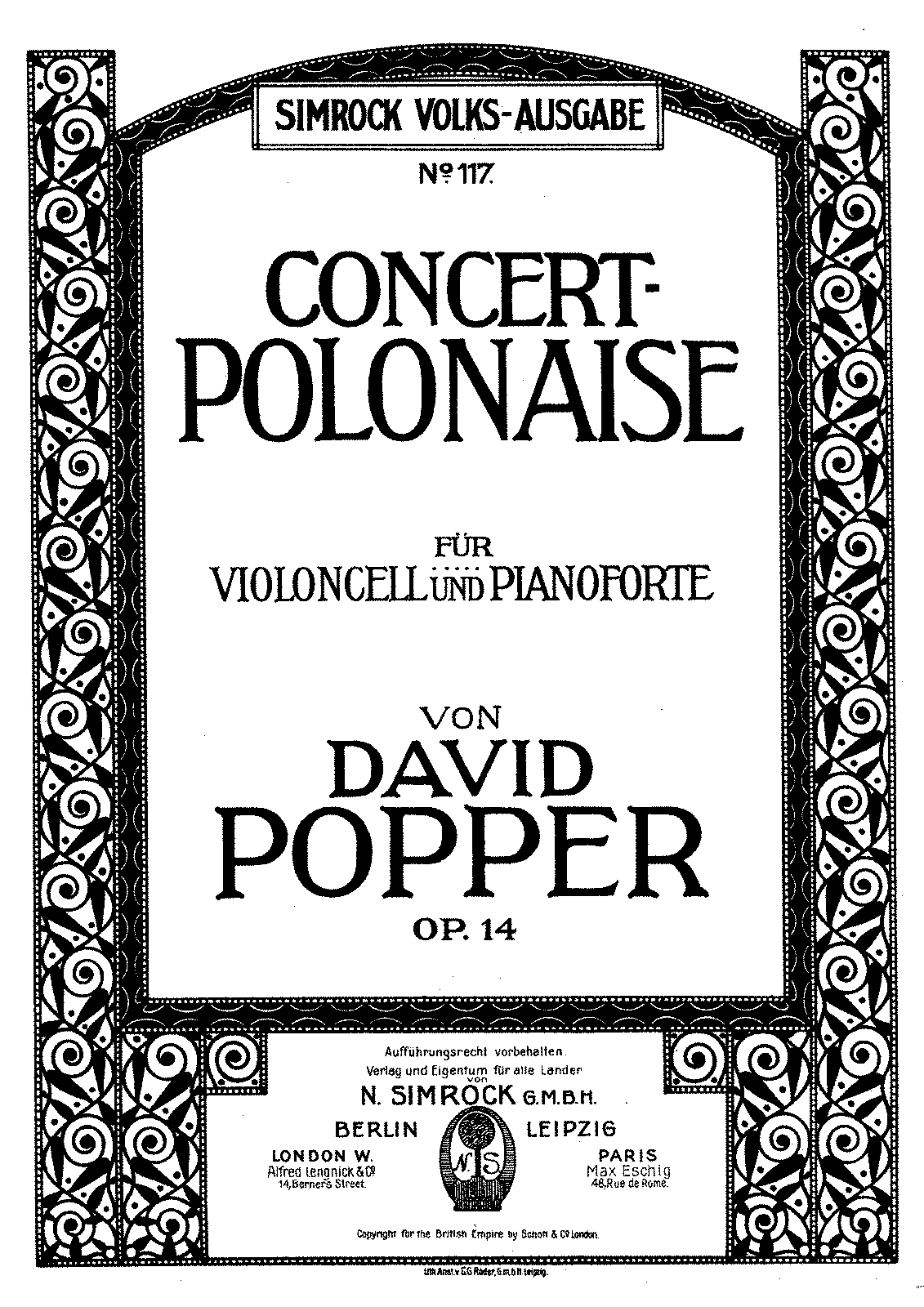
David Popper’s Polonaise de Concert, Op. 14, dedicated to William III, King of the Netherlands, was one of his earliest successes as a composer. Published by Bartholf Senff in Leipzig in 1878 (likely released in late 1877) with the plate number 1304, the work demonstrates Popper’s growing command of virtuosic idiom and his affinity for short forms popularized by composers of the preceding generation. Both in title and in certain musical gestures, the Polonaise de Concert clearly alludes to Henryk Wieniawski’s Polonaise de Concert, Op. 4, published in 1853.

Popper’s Polonaise de Concert is the first of three works he composed in this genre, followed by the Polonaise de Concert in F major, Op. 28 (1880), and the Polonaise No. 3 in D major, Op. 65, No. 3 (1891). The form of Op. 14 is ternary. The opening A section, in D minor, is divided into two large, self-contained parts. After the cadenza, Popper introduces what seems to be an entirely new melody, almost as if restarting the piece; however, only the first part of the opening section returns in the recapitulation. The contrasting middle section, in B-flat major, also comprises two substantial subsections (one lyrical and one virtuosic), both in the same key. The latter portion functions as a retransition, leading back to D minor while foreshadowing thematic material that would later appear in Popper’s Op. 28. The reprise of the first theme concludes with a brilliant coda featuring arpeggios, scales in octaves, bringing the work to an exuberant close.

Although the piano accompaniment is strikingly orchestral in conception, Popper never produced an orchestral version of the Polonaise. In 1897, the young cellist Horace Britt (1881–1971) performed an orchestration of the work by his father with the Lamoureux Orchestra. Subsequent orchestrations have been undertaken by Antonio Tusa (1946) and Jiří Hošek, among others.

(Excerpted from the preface to the Urtext edition by Yuriy Leonovich)